
“Negative Feminism”
In the work of Jean Rhys

Welcome to a Narrative of Their Own, a weekly publication exploring the lives and literature of women.
If you enjoy reading essays on literature, as well as reviews of great books and recommended reading, please consider a free or paid subscription.
I was thinking a lot about stereotypes and the negative connotations of words recently, after somebody was quick to reassure a group I was involved in that they wanted to avoid the use of the word “feminist.”
I always find it difficult to understand this apathy towards aligning ourselves as women with the word feminist or feminism; as though perhaps it makes one sound too “political,” or spoiling for an argument.
This inevitably leads my mind back to literature, and a writer I have long studied and who has caused conflicting ideas around femininity and stereotyping within her work.
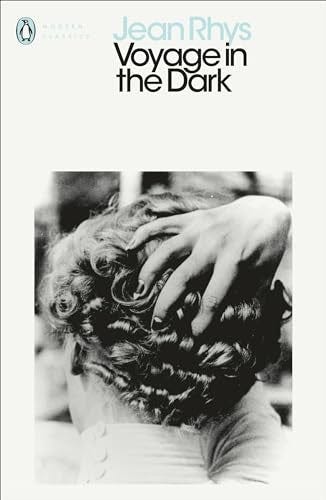
I wrote recently about Jean Rhys’s novel Voyage in the Dark and her subversion of the traditional bildungsroman within that text. I also referenced briefly her female characters, who have often been deemed a mere representation of Rhys herself. One of the criticisms often levelled at Rhys has been the so-called “negative femininity” seen through her representation of female characters within her writing.
In Voyage in the Dark, Rhys’s novel features Anna Morgan, a young woman who travels to England from her Caribbean home. There, she struggles through halfhearted relationships with fickle men, disdain by her landlady and other women, and wonders how she will ever get used to the coldness of both the climate and the people.
Critical studies have sometimes pointed to Rhys’s fiction as representing an ‘anti-feminist’, weak portrayal of her female protagonists. In raising these questions within Voyage in the Dark, there is an alternative viewpoint that has always interested me however: whether in fact Anna, and conversely, her other female characters, triumph as survivors by the end of the text.
Anna’s lack of agency and reliance on men throughout the novel could indicate a reading of her as weak and anti-feminist; she is both a victim and a survivor of circumstance. Anna struggles to thrive in a land foreign to her; cold in both terms of climate and people. She is used by men (although is often complicit in this), and seemingly has no family or real friends to rely on. As with much of Rhys’s female characters, I think there is a sense of distrust amongst other women. Although Anna has ‘friends’ in the story, there is never a real sense of camaraderie or support.
Rhys, too, appears to have struggled for female friendship throughout her life.
Famously a difficult and obstinate writer, Jean Rhys lived much of her later life as a recluse in Bude, Cornwall in the late 1950s and 60s, (which she apparently amusingly referred to as ‘Bude the Obscure’). In the 1960s, she relocated to a small village in Devon.
Following her lively and often tragic early years, which included periods of alcoholism, an abortion which almost killed her, a child who died in early infancy, a spell in prison, and poverty, her novels and short stories are lively and often tragic portrayals of women living in similar circumstances to herself. Many are set in Europe - particularly Paris - and feature women falling in love, becoming involved in love triangles, and the plight of the single, impoverished woman of the early twentieth century.
Falling into abject obscurity and often turning to alcohol to compliment her loneliness and what she saw as rejection by the literary community, Rhys was ‘re-discovered’ when British actor and writer Selma Vaz Dias put out an advertisement to enquire about her whereabouts. She was seeking the rights to adapt one of Rhys’s earlier novels, Good Morning Midnight, for radio.
Luckily, Rhys responded.
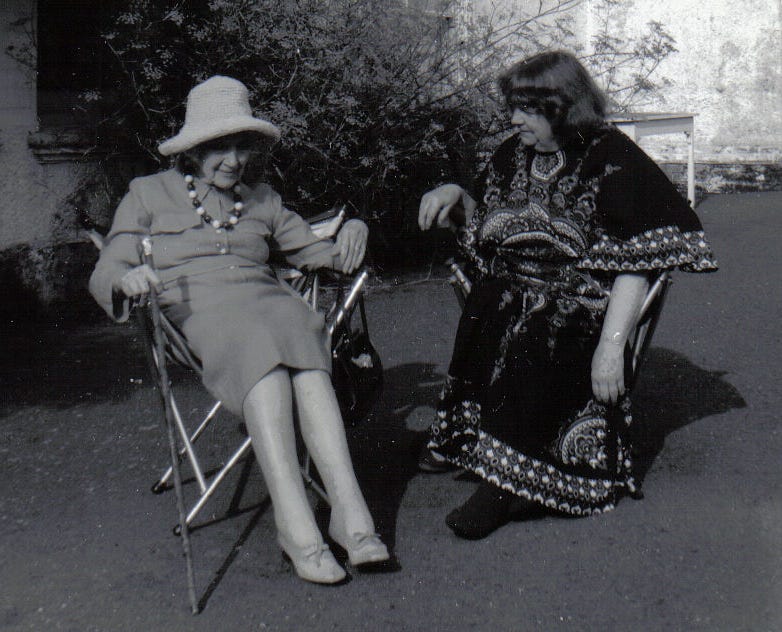

Rhys had begun work on her novel Wide Sargasso Sea, a prequel to Charlotte Brontë’s Jane Eyre, as early as the 1950s. When UK publisher Andre Deutsch showed interest in publishing the novel, an editor at the publishing house, Diana Athill, together with fellow editor Francis Wyndham, both believing in the talent of Rhys, began the attempt to revive interest in her work.
What sprung from this first contact was a warm, often exasperating, but supportive friendship between the two women.
Though Athill remained close friends with Rhys until her death in 1979, it was not always an easy role for her. Rhys was said to be quite childlike in her attitude, often demanding to be taken care of, and was extremely pedantic about her writing. Despite (or because of) this, following Rhys’s death, Athill claimed that she had learnt a lot about writing from Rhys, including how to write concisely and with clarity.
I wrote in more depth about Rhys’s re-discovery and the friendship between Athill and Rhys in my essay ‘Just Good Friends.’
Within Voyage in the Dark, Anna struggles to be supported by the women around her. As a counter-character to Anna, Laurie, an older female friend from Anna’s touring days with the theatre troupe, who is experienced in dating wealthy men, ‘helps’ her to get an abortion, but then leaves her and is quite unkind afterwards, almost appearing to blame Anna for her predicament:
‘Oh, don’t be a fool,’ Laurie said. ‘She’ll be all right. It’s bound to stop in a minute’, (p183).1
Ethel, the landlady who takes Anna in to help with her manicuring and massage business, is similarly unkind and throws her out. There is a definite sense from the lack of sympathy that Anna is to blame for her own circumstances. Anna is an outsider in all senses, alienated within her white Creole identity in both England and her homeland. Many of Rhys’s female characters struggle with this alienation, marginalised whether for their mixed heritage or simply for being single women of little means. As she lays in bed, Anna tells us:
‘I’m glad it happened when nobody was here because I hate people’, (p183).
This echoes Anna’s alienation from others, and suggests a lack of sympathetic adults to whom she can turn. I think it also reflects a lot of Rhys’s own experiences of loneliness and isolation.
Anna appears to accept this for herself by the end of the novel, but there is no satisfactory resolution for her, indicating a subversion of the traditional bildungsroman or epiphanic ending usual in such modernist texts.
Critic Anne Cunningham appears to agree on this point, stating that in the traditional canon, a bildungsroman is:
‘a story of an education that assumes experience can lead to insight’,
whereas in comparison:
‘Rhys’s fiction destabilises these assumptions because of the marginalised spaces her protagonists inhabit. Anna’s Creole subjectivity, for example, makes her an outsider in both the West Indies and in England’.2
Again, this echoes Rhys’s own life.
Returning to the original suggestion of Rhys’s often doomed female characters such as Anna as ‘anti-feminist’, however, I found Cunningham’s ideas interesting on this point.
Disagreeing with such a reading, she claims that Rhys’s writing:
‘is steeped in a rhetoric of failure: the majority of her protagonists are unwilling or unable to abide by the socially prescribed codes of feminine respectability, and are therefore marginalised or even excluded from the various communities they inhabit.’
Such ideas are significant, allowing us to see Rhys as not simply showing the dire consequences for young women like Anna Morgan, attempting to carve out a meagre existence with the reliance on men, but as examples of ‘how passivity functions as resistance.’ Evidence of this, Cunningham claims, is seen by:
‘Rhys’s heroine’s refusal to behave according to British notions of white feminine respectability in work and social situations’.
In response to the often quoted ‘one Rhysian woman,’ and considering Rhys’s use of autobiography, Cunningham claims thatL
‘Failure permeated Jean Rhys’s life, and she wove it into her textual world.’
Anna’s ‘failure’, if we are to follow Cunningham’s reading, is a way that Rhys ‘jettisons patriarchal femininity, albeit through negation’. This suggests that, far from an idea of ‘anti-feminism’, Rhys’s protagonists are instead critiquing the standard view of patriarchal femininity.
Cunningham goes further, suggesting that Rhys’s choices within the novel can be read as ‘a form of non-direct activism’.
I find Cunningham’s suggestions fascinating. She suggests that Rhys deliberately ‘employs a negative feminism’, which she uses through her female characters such as Anna to ‘question less resistant, positive feminist accounts’. We could consider this, for example, in the ways that history may point to more liberation for women during the period of Rhys’s novels. Her often unforgiving narratives show that for some young women without the security of family or marriage, life could be difficult.
For Cunningham however:
‘the Rhysian protagonist demonstrates that a feminine subjectivity based on negation and failure is preferable to the prescribed choices available to women.’
I find these ideas particularly compelling, and believe there is a good argument to suggest that Rhys deliberately employed negative femininity in order to portray the reality for women such as herself.
In her autobiography, unfinished at her death, Rhys confesses:
‘I must write. If I stop writing my life will have been an abject failure. It is that already to other people. But it could be an abject failure to myself. I will not have earned death.’3
Rhys struggled through poverty, disappointing relationships, mothering (both of herself and as a mother herself), and addiction to alcohol. Her work displays much of these themes through her female protagonists, which at times, can make for depressing reading.
But her modernist writing through both her accomplished short stories and her novels reveal an intelligence that feels in opposition to the image we often get of a passive and helpless woman.
I think there is reason to believe that Jean Rhys’s personal experience added depth to much of her fictional novels, though it is too simplistic to say that she merely wrote fictionalized autobiography. As has been argued by critics, Rhys undoubtedly imbibed her female characters, none more so than Anna Morgan, with her own background and emotional turmoil. She did this through a modernist aesthetic, adopting stylistic effects from the genre such as symbolism, dreamlike sequences, and first-person narration, as well as internal, stream-of-consciousness dialogue.
Yet, she did not fall squarely within this genre, either. This can be seen in particular with her disregard for the epiphany style ending, and the gritty realism of Anna’s situation in Voyage in the Dark. Her female narrators don’t always - or often - reach a satisfactory conclusion or outcome by the end of her books. Neither do they decide to take action. This has led to many of the claims of her endorsing “negative feminism” in her work. She appears to show her protagonists as helpless women; women without a purpose or intellect to remove themselves from their dire situations.
But I think Anne Cunningham makes a good case against critics who claim that Anna and others display weak, ‘anti-feminist’ characteristics, concluding that such female characters in Rhys’s work display elements of resistance to societal expectations of femininity.
Could it be in fact that Rhys chose her female characters as examples of how women are subjugated within the patriarchal system? They are usually outsiders; poor young women who have no fixed income, career or agency. In this way, they can certainly be seen to echo her own reality.
Jean Rhys, Voyage in the Dark, (Penguin: 2000, [1934]). (Further references apply to this edition).
Anne Cunningham, “Get on or Get Out:” Failure and Negative Femininity in Jean Rhys’s Voyage in the Dark, Modern Fiction Studies, Summer 2013, Vol. 59. (Further references apply to this article).
Jean Rhys, Smile Please: An Unfinished Autobiography, (Penguin: 2016).
This is so thoughtful and interesting, Kate. It blows my mind to still see the fear of the word ‘feminism’. (And it rankles when that POV crops up and is widely restacked on Substack). And you’ve ably demonstrated here there are so so many ways that it can be presented through literature (and in life). Nothing radical required, just an observation of inherent inequality. I always say this when you offer up Rhys, but I must read further than WSS.
Spot on investigation! I’m far from a Rhys scholar, but I think that more generally, there is not enough placed on looking at fiction as mirrors of insight that we are to consider within a world rather then something with a clear message. Her work certainly questions and grapples with a woman’s place in society both personally and more generally. Thanks for this compelling read, Kate!