
Reading Reflections
Literary Rabbit Holes


Welcome to A Narrative of their Own, a weekly publication exploring the lives and literature of women.
If you enjoy reading essays on literature, as well as reviews of great books and recommended reading, please consider a free or paid subscription.
Occasionally, I take a brief break from essays exploring the themes of women’s literature and lives and reflect on my own recent reading.
At the end of last year, I went down a real rabbit hole in my reading.
This isn’t a complaint: I love it when an idea or theme from reading takes hold and doesn’t let go.
Do you get this?
I think many readers will recognise it: You find a book you really enjoy, and then you deliberately go out seeking more novels that are either similar to the book or by the same author.

You can also find yourself scrolling online for information on the themes, listening to music or other art associated with the book, or just finding yourself wanting to visit the places mentioned.
In my case last year, I went down a couple of these.
Firstly, women in academia, and secondly, women and art.
Women In Academia
Within this category, I wrote previously about my affection for Alison Espach’s deceivingly perceptive novel, The Wedding People, which features a married university lecturer, Phoebe, who is struggling to finish a book on weddings in Victorian literature.
Following an unwelcome divorce, she travels to a luxury resort to end it all, where she is ‘rescued’ by bride-to-be Lila, and gets swept up in the lives of the other wedding guests.
The novel explores work, ambition, infertility, grief, and the ways in which women make themselves small in order to please others.
“Your husband is not going to take care of you the way you think,” Phoebe says. “Nobody can take care of you the way you need to take care of yourself. It’s your job to take care of yourself like that.” ― The Wedding People by Alison Espach
Following on from The Wedding People, I asked readers to recommend other novels featuring female academics, leading me to my next read, Vladimir by Julia May Jonas. A strange, intoxicating novel featuring a middle-aged woman who falls for a younger professor after her fellow-professor husband is accused of sexually inappropriate conduct with several young female students.

She takes the bold stance of blaming the women, rather than her husband, and the novel explores how far she herself has been exploited, and her own increasingly dangerous behaviour towards the young Vladimir.
‘...a feeling of pleasure revved within me, like the acceleration of a motor. The sight of him, the fact of Vladimir’s bound body, chained up in my hideaway cabin in the middle of nowhere, was fantastic and absurd.’ - Vladimir by Julia May Jonas
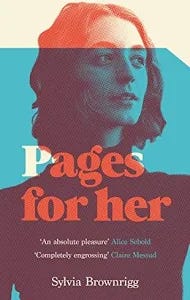
Next, I remembered a book I read several years ago, Sylvia Brownrigg’s Pages for Her. This is not a novel (or author) I have heard discussed anywhere at all but one I picked up several years ago at my library and which I then shared with my daughter. I discovered after reading that it was actually a sequel, the first of which is Pages for You.
In Pages for Her, Brownrigg excavates the life of a married writer and teacher of creative writing, Flannery Jansen. At the opening of the novel, Flannery receives an email inviting her back to her alma mater, Yale, where she will give a talk on a weekend celebrating Women Writing the World.
We learn that she had one hugely successful memoir after graduating, detailing her trip around Mexico in search of her errant father, accompanied by her girlfriend at the time. This was followed up by a less well-received novel and Flannery’s unexpected pregnancy to a flamboyant artist, Charles Marshall.
Now deep into marriage and motherhood, Flannery is flung back to reminiscing about her early days at Yale as an undergrad, when she fell into an erotic and all-consuming relationship with a more experienced post-graduate, Anne Arden. Over the years, Flannery has traced the glowing career of Anne, a successful academic and author, and her relationship with the man she returned to at the end of their affair.
We see an increasingly frustrated Flannery, enduring the tedium of her days as she struggles with her creativity in the shadow of her larger-than-life husband. As the day of the conference draws closer, where she will come face-to-face with her lost love, the tension builds.
‘She was a writer, yes, or had been once, and sometimes she could still be beautifully articulate.
Other times, she simply could not find the right thing, or anything at all, to say.’
― Pages for Her by Sylvia Brownrigg
The book also has a section told from the point of view of Anne, which I felt was a bit less satisfying, as Flannery was by far the most intriguing character for me. When she attends the conference, tasting creative freedom for the first time in years, it is a joy to see her unfold.
Pages for You is an equally enjoyable novel, with some beautiful prose. This tells the story of Flannery and Anne’s relationship and their time at Yale. For me though, the sequel is the clincher, likely because I read it first and also because I can associate more closely with the older Flannery.
The Female Artist
The rabbit hole I found myself in at the end of last year was equally as enriching, starting with The Last Sane Woman, an unusual, lyrical novel by the poet Hannah Regel.
In this book, we meet ceramics graduate, Nicola, who comes across one half of a correspondence from a dead potter to her best friend, written in the nineteen-sixties. Although the other half of the correspondence is missing, Nicola begins to piece together the life of the potter, Donna Dreeman, and her unravelling emotional well-being, which mirrors that of Nicola’s herself. Nicola becomes obsessed in discovering why Donna took her own life.
As well as the two potters, the story is told from the point of view of a third woman, Susan, the friend to whom Donna’s letters are written.
‘I wish I was sensible like you. You would never land yourself in a ditch like this. Sensible Susan. Well, you don’t know how lucky you are!’ - The Last Sane Woman by Hannah Regel
At times confusing and perhaps a little over-crowded with the three women, and set in different time-frames, the book is written so lyrically that it gets away with it. Written in a fragmentary narrative, I sped through it in a few days.

Eager for more art-inspired stories, I next got my hands on Ayşegül Savaş’ novel White on White. I was keen to explore more of her work after loving The Anthropologists and her short story collection, Long Distance.
I love Savas’ writing style, which is full of short paragraphs and chapters (Note: I love the modernist fragmentary style of writing!) and White on White is in this similar vein.
The book is told from the point of view of a student living in the empty city apartment of a married couple, an artist who has her studio in the same building. When the artist unexpectedly arrives to work in her studio, the two women become friends, sharing coffee and walking around the city together.
As the artist continues to tell her stories to the student, however, it becomes increasingly clear that she is unravelling. It appears she has been sent away to paint by her husband and that they are experiencing marriage difficulties.
The book is engrossing and again, its lyrical, fragmentary feel was a quick read.

My next book on the artist-odyssey, Painting Time by Maylis de Kerangal (translated by Jessica Moore), was a bit more in-depth, but just as lyrically written.
This had been recommended by a few readers. It follows the life of three students as they experience their first year of studying trompe-l’œil and its artisans; those who conjure marble, wood, and ethereal skyscapes from pigment and lacquer at Institut Supérieur de Peinture in Brussels.
The central characters are Kate, a 6ft Glaswegian nightclub bouncer; the cryptic but talented Jonas; and Paula, the central narrator throughout the book.
The novel contains a lot of detail on their painting styles, but was again written so deeply, with such rich description, that I found it intoxicating. The Guardian referenced it as a novel ‘which braids technical fluency with winged prose,’ and I think this gets at the heart of Kerangal’s writing style.
‘Paula, unfolding her fingers one by one, lists the litany of colour names they all know by heart, enunciating the syllables as though she were bursting capsules of pure sensation one by one...’ - Painting Time by Maylis de Kerangal
Though the book is primarily about their student days and nights, it also leads into what they do after their course ends, as they drift apart and back together, remaining firm friends throughout the years and their varying careers, finding their place in the art world.
I am now (patiently) awaiting the arrival of The Artist by Lucy Steeds, which I have a hold on at the library and which is taking forever…but it seems that wherever I go, somebody is reading this book. I will let you know if it feeds my artist thirst when I finally read it 😂
I have temporarily paused my academic/artist rabbit hole reading for now, as I wanted to dive into some Christmas and birthday book gifts, starting with Anne Tyler’s Three Days in June (which I enjoyed), and a return to Jean Rhys’s first novel, Quartet. I am planning an informal reading project of reading (and re-reading) all of Rhys throughout this year, as well as criticism around her work, potentially for a book idea I’ve been working on.
I have also been reflecting back on my own reading practice in general as we near the end of the second month of the year. One of my aims for 2026 was to keep a handwritten list of books read. I confessed at the start of January that I had never done this before, and I get such reading-envy at the sight of other Substackers’ neat, handwritten lists.
But as happens so often: I am a Rebel at heart. I find myself irritated that I “only” have two books listed for this month, despite one being a thick hardback that I’m thoroughly enjoying reading! Something about seeing the books listed down on paper starts to eat at my confidence, making me want to race through a book in order to write it down. This is definitely not the way I wish to conduct my reading life! Sitting and enjoying a good book, as long as it takes to read it, should be a more rewarding goal than the act of writing it down.
I also rediscovered the joy of reading a play this month, something that I used to enjoy as part of my literature studies. If you’re looking for a way to incorporate classic literature but in a more accessible way, I can’t recommend this enough!
I would love to know what you’ve been reading lately and whether you have read any of the titles mentioned here, or whether you are following any reading projects this year.
I’d also love to hear about your own “rabbit holes” and whether you have any more recommendations for books about academic women or the female artist. I am thirsty for more!
Substack readers have the BEST book taste! 😀
Love this! I keep a folder of lists in my notebook programme called "Books From Books", because every book I read seems to spark its own follow-up reading list. I'd have to live to at least 254 to be able to read them all, but I guess it's better than being stuck for ideas... 🙄
As I order most of my books through our rural library or their interlibrary loan, they keep a list of what I've checked out. In winter sometimes I re-read what's on my own shelves. Somehow this led me back to Diana Athill, whom I've loved ever since the New Yorker (I think) reviewed "Somewhere Near the End" years ago. And then Athill kept on living and writing for years. I ordered the one Athill novel our library has, "Don't Look at Me Like that" about the character, Meg's, late teens and early twenties. So much of Meg's agony resonates from those years for me. As you know, Athill represented Rhys and knew her quite well.