


Welcome to A Narrative of their Own, a weekly publication exploring the lives and literature of women.
If you enjoy reading essays on literature, as well as reviews of great books and recommended reading, please consider a free or paid subscription.
In researching the life and writing of Jean Rhys for an ongoing project, I came across an interesting podcast episode on Naomi Alderman’s Human Intelligence. In an episode on Rhys, Alderman features Senior Lecturer in Modernism at the University of Liverpool, Sophie Oliver, who states that Rhys may have been the first example of a writer to take a peripheral character from classic literature and give her her own story.
Though Oliver points to many earlier re-tellings of stories, from Greek tragedies to the plays of Shakespeare, Jean Rhys does something new in her final novel, published in 1966, Wide Sargasso Sea. She does not re-tell Charlotte Brontë’s earlier classic Jane Eyre, but instead places the peripheral character of Bertha, Brontë’s ‘mad woman in the attic,’ centre stage.
Brontë gave Bertha no backstory, indicating that we, the readers, need not care about her. As Alderman points out, Bertha’s only role in the story of Jane Eyre is to be a barrier to Jane marrying Mr Rochester. Bertha stands in as the impediment; the ‘mad woman’ to whom Rochester has been trapped into marriage. This allows for Jane to become the heroine of the story.
Critics have previously asserted the reference to ‘otherness’ within Brontë’s novel. Bertha is described as having a Creole mother, a term that, within the nineteenth-century, was somewhat ambiguous, referring to both Black and white people from the West Indies. We can define from Brontë’s text that Bertha is associated with colonised Black races from the region, with references to Bertha having both a ‘discoloured’ and ‘savage’ face, and lips ‘swelled and dark.’ The novel has been criticised as one which does not merely allow for a feminist bildungsroman of the central character, but a white feminist bildungsroman, recognising only the minority of women at the cost of the oppression of others.
As critic Gayatri Chakravorty Spivak has pointed out, Brontë’s unquestioning of imperialist power claims Bertha as the ‘fictive other,’ who subsequently gets destroyed ‘so that Jane Eyre can become the feminist individualist heroine of British fiction.’ Within this framework, Brontë’s Jane only reaches her full potential at the cost of dehumanising the irredeemably ‘other’ Bertha. Much of this dehumanising takes effect through the refusal to give Bertha a backstory, or even any humanising traits in the novel.

Reading the novel during her first years in England as a teenager, Rhys recognised herself in the unfortunate Bertha, whom Brontë mentions in passing is a Creole, brought across to England from Jamaica.
Rhys had arrived in England from Dominica in the West Indies, the daughter of a white Creole mother and white Welsh father, and had felt utter despair at her life in England. Encountering Bertha in Brontë’s novel, trapped in the attic, a forgotten woman who nobody cared for, Rhys recognised her own history.
Deciding to tell the story of Bertha and what had led her to her life in the attic at Thornfield Hall led to a profound shift in the literary landscape.
Re-naming Bertha as ‘Antoinette,’ in her first act of defiance on Bertha’s behalf, (Bertha being the name Rochester bestows upon her, similar to how Ford Madox Ford had renamed Jean Rhys), Wide Sargasso Sea moves away from the traditional novel hero trope and instead replaces it with the marginalised voice of otherness.
Though this was the first time Rhys had utilised such a character from classic literature, her four early novels, written before WWII, all feature marginalised women representing the life of the underdog. Poverty-stricken alcoholics, wandering the streets of Paris and London, these were women living on the margins of a cold and often cruel society. A Rhysian woman lingers at the fringes. Her own stories become enmeshed in those of the male enablers who pick her up for a time, only to discard her once she becomes tiresome to them. Though her early protagonists’ attempt to divulge a little of their backstories, often through reveries and fragmented memories, they are summarily disregarded by others.
The women’s voices go unheard and quietened.
But it was within the pages of Wide Sargasso Sea, Rhys’s final novel, that her talent was finally recognised through the innovation and reinvention of the marginalised Bertha/Antoinette.
In Jane Eyre, Bertha is one-dimensional; she literally does not speak, portrayed as unfeminine and animalistic.
‘The clothed hyena rose up, and stood tall on its hind-feet.’
Brontë relays that Bertha comes from a family of ‘lunatics’ and that her Creole mother before her was a mad drunkard. The other inhabitants of the household fear her. Rochester tells Jane:
‘To tell me that I had already a wife is empty mockery; you know now that I had but a hideous demon.’
This leads Jane to feeling sympathy for Rochester, who indicates he had been tricked into marrying such a ‘creature.’
Rhys read these lines and saw that this could not be the whole story. What had made Bertha such a wretched figure?
Sophie Oliver states that the assumption throughout Brontë’s novel is that Bertha is ‘mad.’ What Rhys does in her story is show us how she gets to that point. She gives the reader the social history of Antoinette’s homeland, delving into colonialism, imperialism, and enslaved people, as well as misogynistic culture. Rhys’s novel shows how these forces combine to create the fate which befalls Antoinette, leading to the pitiful creature she becomes and the life of confinement in Rochester’s attic.
Interestingly, as has been pointed out by some critics, Rhys also gives voice to the young Rochester, sent to Dominica to meet his new bride. In Wide Sargasso Sea, the narrative is split between the voice of Antoinette and Rochester, showing a maturity in Rhys’s approach since her earlier work.
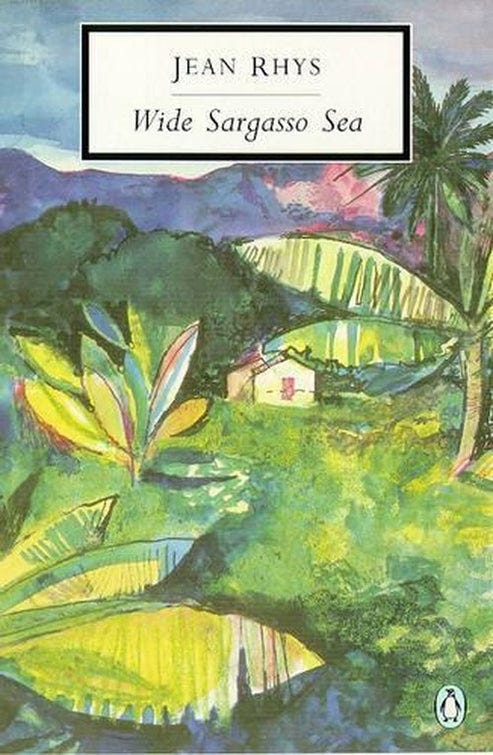
Rhys herself stated her dismay on first encountering Brontë’s Jane Eyre, finding herself disappointed at the stereotyping of the West Indies she found typical in colonial stories by English authors, saying:
‘But then I’ve never believed in Charlotte’s lunatic, that’s why I wrote this book and really what a devil it’s been.’
She goes on to explain:
‘I came to England between sixteen and seventeen, a very impressionistic age and Jane Eyre was one of the books I read then. Of course Charlotte’s Bertha makes her own world, of course she convinces you, and that makes the poor Creole lunatic all the more dreadful. I remember being quite shocked and when I re-read it rather annoyed. “That’s only one side - the English side” sort of thing.’
Rhys confessed to her agent Diana Athill that the idea for Wide Sargasso Sea had occurred to her ‘years and years’ after first reading the book, an undertaking which she went on to find more difficult than she thought. On her own admission, Rhys preferred basing her writing on the facts of her own life to begin with, and stated: ‘I haven’t much imagination really.’ Despite this, her novel became the magnum opus of her literary life, catapulting her into a late fame, something she wasn’t altogether comfortable with.
The use of taking peripheral characters out of classic literature and into the work of contemporary novelists is something that is now far more recognised. Perhaps most notable in relation to Rhys’s Wide Sargasso Sea is Percival Everett’s James, which tells the classic story of Mark Twain’s Adventures of Huckleberry Finn from the point of view of the enslaved ‘Jim.’ In both Everett and Rhys’s novels, the stories of the marginalised characters are brought forth, giving voice to the voiceless and providing a counterpoint to accepted stereotyping of earlier literature.
Other later examples of classic re-tellings through marginalised voices include Jo Baker’s Longbourn, which takes Jane Austen’s story of Pride and Prejudice and tells it from the point of view of the servants working in the Bennet household, and Margaret Atwood’s The Penelopiad, which retells The Odyssey through the story of Penelope. Recent titles have also included Sandra Newman’s Julia, a retelling of George Orwell’s Nineteen-Eighty-Four through the voice of the girlfriend of Winston Smith.
I was recently kindly sent an early copy of Rose Tremain’s latest novel The Housekeeper, in which she tells the fictional story of Daphne du Maurier’s writing of Rebecca. The story is told through the voice of the housekeeper of Manderville Hall, a stately home in which a Polish housekeeper named Mrs Danowski (known as ‘Danni) works. Relaying the story of her meeting with the young novelist Daphne du Maurier, and their ensuing passionate affair, the book is about betrayal and shame, as well as the otherness of being a Jewish woman in a foreign landscape.
When du Maurier twists the real-life persona of Mrs Danowski into Mrs Danvers, the eponymous and terrifying housekeeper of Manderley in her bestselling novel Rebecca, the real-life housekeeper Danni is left heartbroken and betrayed.
With a feature film of The Housekeeper in the works, starring Anthony Hopkins and Helena Bonham-Carter, it appears that the trope of taking peripheral characters and marginalised voices, and giving them their own backstories, is something that will continue to fascinate and feed into the writing of novelists.
As a writer with a deep admiration of Jean Rhys, I like to think she started the legacy and showed us the way to opening the dialogue for the silenced and forgotten.
I remember discovering Jean Rhys in college via Wide Sargasso Sea and feeling like a door had been blown open about what stories could really mean and other ways of telling them. You can’t unsee Bertha’s, Antoinette, story once you read Rhys‘s version. And that’s the point. It made me wonder why did I accept it the first time around, maybe because a woman wrote it? Because I wanted Jane and Rochester to end up together? Afterwards, I read as much of Jeanne as I could find which wasn’t that much in the late 90s before online shopping. But after reading your various articles about her, I think it’s time for a revisit.
Thanks Kate, what a fascinating article. I loved Wide Sargasso Sea and am very interested in minor characters becoming central to a narrative of their own. There's so much potential. I too was lucky enough to recently read Rose Tremain's The Housekeeper and thought it was wonderfully compelling.