
Becoming George
An exploration of the nineteenth-century writer George Sand


Welcome to A Narrative of their Own, a weekly publication exploring the lives and literature of women.
If you enjoy reading essays on literature, as well as reviews of great books and recommended reading, please consider a free or paid subscription.
If you buy books through the links in this essay, A Narrative of Their Own may earn a small commission from Bookshop.org, whose fees support independent bookshops.
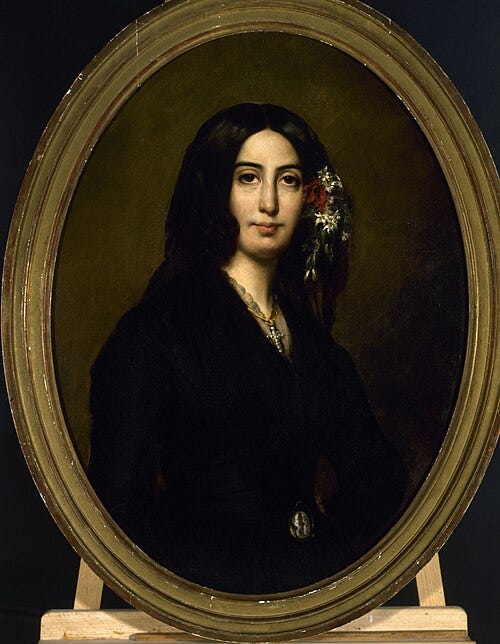
‘It would be hard to find a more courageous and perverse, iconic yet controversial figure in European literary history than George Sand,’ writes biographer Fiona Sampson, author of the newly released Becoming George: The Invention of George Sand* celebrating the 150th anniversary of Sand’s death.
In the nineteenth-century, George Sand was one of the great romantics. Her writing helped to transform and shift cultural attitudes. She was admired by the literary heavyweights of her time, including Victor Hugo and Gustave Flaubert, who referred to her as ‘one of the great figures of France.’
Sampson’s highly readable biography seeks to debunk some of the myths surrounding Sand, whom she states was ‘a pioneering, ecological, feminist and republican writer.’1
Sampson reports discovering a new vision of Sand through researching her biography, which she beautifully says became:
‘like the palimpsest of an overpainted canvas.’
Within this a hidden story emerged of:
‘someone who had to struggle to become herself.’
Astutely, Sampson suggests that this is, to some extent, true of all writers, and potentially to every person alive.
‘All writers write themselves into being writers.’
Born Amantine Lucile Aurore Dupin de Francueil in 1804, to a Paris sex worker and an aristocratic cavalry officer, the woman who would become George Sand was a simple convent girl from the provinces. Sand’s legitimacy and a life-changing inheritance was luckily secured by her parents’ shotgun marriage just a month before her birth.
Sand herself endured her own failed marriage at the age of 18, to an alcoholic husband, later divorcing. The marriage resulted in two children, although the paternity of her daughter was possibly the result of an affair.
Sand later left for Paris with a younger lover, Jules Sandeau, with whom she collaborated in writing commercial fiction. She did not choose to abandon her children, however, being awarded custody, unusual for the era.
Sand later adapted Sandeau’s name into the nom de plume that would make her famous. Although a male pen name was not original, Sand’s resembles what Sampson points out is:
‘a gleeful chopping down to size. “George” isn’t even a real French name, but a shortening of “Georges”.’
Sand’s flamboyant promiscuity in Paris gave her a certain notoriety. Portrayed wearing men’s clothes, something she picked up as a teenager in order to ride better, this became synonymous with her status as ‘one of the literary “boys”,’ enabling her to move freely around the city. This wasn’t necessarily something unheard of: many women were taking advantage of the freedom of movement that cross-dressing allowed, leading to an 1800 bylaw in the city prohibiting it.
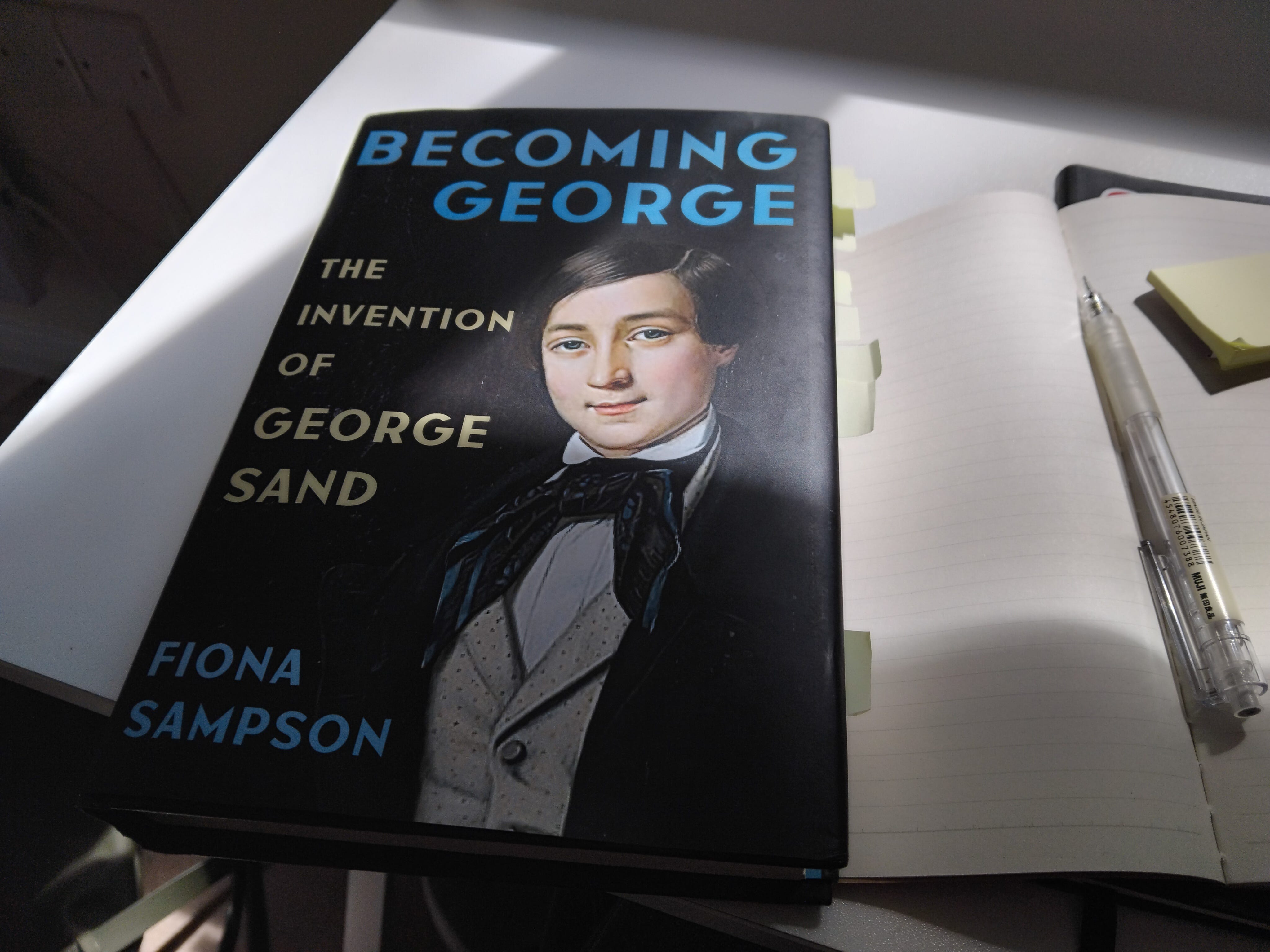
In her book Writing a Woman’s Life, Carolyn G Heilbrun quotes Sand stating that:
‘Having dressed as a boy in my childhood, and having hunted in knee breeches and shirt, such dress was hardly new to me, and I was not shocked to put it on again.’2
Sand, who was a prolific polymath, published a total of seventy novels, as well as travel writing, criticism, autobiography, political polemic and visionary essays on the interconnectedness of the natural world. She also founded several politically progressive periodicals and became a highly successful playwright.
By the age of 23, Sand was:
‘a cross-dressing, cigar-smoking, highly successful novelist, living a racily metropolitan existence in Parisian bohemia.’
She enjoyed affairs with a series of men and at least one celebrated woman, leading to her being caricatured as:
‘a figure of immoderate productivity and vast appetite.’
Yet, her writing output would strongly suggest otherwise. Emily Brontë would later be highly influenced by Sand’s work, leading to her own novel, Wuthering Heights.
Carolyn G Heilbrun suggests that Sand liked women and encouraged younger women in particular all her life. She also argues that although Sand had many lovers, these were always just one at a time, and that she was the lover and friend of some of the outstanding creative men of her day. She also ran a comfortable, hospitable home, eventually delighting in her grandchildren.
In her era, Sand was one of the most famous writers in the world, claims Sampson; an era when books were akin to the glamour of Hollywood movies.
Giving a modern slant to the life and work of Sand, Samspon references her as:
‘the very model of the writer as freelancer, calling in at the newspaper bureau to chat to her editor or mailing in copy.’
Sand’s very behaviour, of riding astride, going around Paris into theatres and bars and taking a desk in the office of La Figaro, as a woman, was a violation of acceptability according to the gender norms of the time. Though she attempted to reduce these perceptions, dressing to pass as a man - though she did not always successfully disguise herself.
Though not a member of the literary salons of the earlier period, Sand emerged within the networking writing milieu of Paris as almost the first woman to do so, preceding writer George Eliot (formerly Mary Ann Evans) by a couple of decades. But unlike some of her female predecessors, Sand entered as a writer, not as somebody else’s muse.
Despite initially publishing under ‘J. Sand’, as a collaboration with her younger male lover Jules Sandeau, Sand soon took on the whole of the couple’s joint commissions. Even though partially incorporating his name was the stepping stone which allowed for her to begin working in the writing world, Sampson claims that Sandeau was far from a mentor, rather resembling what she so eloquently refers to as:
‘a sort of literary beard.’
As Sampson points out, when Sand first arrived on the Paris literary scene in 1831 at the age of 27, as a writer for Le Figaro, she was something of a notorious figure. Newspaper gossip columns portrayed her as a man-hater and a man-eater, something Sampson claims has continued through the words of male critics ever since. Writer Charles Baudelaire, for instance, labelled her ‘a latrine’, and Friedrich Nietzsche ‘a dairy cow’.
Though Sand is often recognised for dressing in male attire, she also wore dresses, and enjoyed mostly heterosexual flings, including famous lovers and a series of younger male lovers.
Most famously, in 1838, she became the partner of the pianist and composer, Frédéric Chopin. This did not lead to a happy period for Sand. Initially taking the composer to a monastery in Mallorca during their first year together for his health, Chopin’s later death to tuberculosis was often blamed on the year the couple spent in the monastery, due to the freak weather there making his health worse.
As Sampson iterates, tradition has made Sand the villain of this piece. In truth, however, she cared for Chopin for the nine years they spent together. Not only in the traditional sense, but also assuming financial responsibility in order for him to focus on composing. Despite this, we see from Sand’s letters that Chopin in fact did not desire her, and Chopin’s own letters indicate his explicitly sexual affection for his male friends.
Despite this, Sand continued to write, never giving up on the vocation which drove her.

Sampson points out that Sand’s writing technique was completely radical. She managed to express the emotional, intimate side of social injustice in a wholly new way. Her stories featured lived experience, beginning with her debut novel, Indiana, in 1832, a story of the cruelty of arranged marriages. Unsurprisingly, women and children were placed at the centre of their own narratives.
In the 1840’s, Sand turned her writing attention to the rural poor, in novels like The Devil’s Pool, once again years ahead of her contemporaries.
Sampson points to what she calls Sand’s:
‘shapeshifting refusal to be pigeonholed.’
Whether she was writing copy for editors, or going on to tutor two generations of her own family, Sand remarkably managed it all. Simultaneously, sand was a vociferous campaigner for bringing an end to arranged marriage and the Revolutionary progressives of 1848, as well as the rights of a young rape victim with mental disabilities. Even her fictional characters were original and subversive: in Indiana, the protagonist is of global majority heritage.
Her work also encompassed discussions on ecology; both her novels and her essays present the natural world:
‘as something independent and interdependent,’
prefiguring the work of James Lovelock a century later. Sand being Sand, however, she:
‘personified nature as Corambé, a non-binary divinity of her own invention.’
Fiona Sampson’s lively discovery of the woman behind George Sand explores her relevance for literary women today.
In Sand’s refusal to conform to the gendered standards of her time and her choice to storm the male bastions of literary Europe, Sampson eloquently insists that George Sand:
‘blazed a trail for future female artists from Elizabeth Gaskell to Louise Bourgeois to Taylor Swift.’
Sand’s subversive sartorial choices, the cigar-smoking and all the rest, show a brave, humorous, adaptive woman who was willing to challenge authority. She became known in her home region of France as ‘the Good Lady of Nohant.’
Fiona Sampson’s immersive biography reflects on how Sand managed to pull all the strands of her amazingly prolific body of work and personal life off. She points to Sand’s good friend and fellow writer Gustave Flaubert, who drew attention to Sand’s storytelling as the thread which integrated all of her work. Speaking of Sand’s funeral in 1876, Flaubert reported that both celebrities and villagers mingled:
‘up to our ankles in mud [and] a gentle rain’. This was, he points out, ‘like a chapter in one of her books’.
Fiona Sampson, Becoming George: The Invention of George Sand, (W.W.Norton: New York), 2026. (All future references to this edition).
*A copy of this biography was kindly gifted.
Carolyn G Heilbrun, Writing a Woman’s Life, (The Women’s Press: London), 1989. (All future references to this edition).
I’m reading the popular history “Paris in Ruins.” Sand was mentioned early on, so I read up on her via Wikipedia. This is a timely and welcome addition to the little bit I learned!
Such a great piece as ever. It makes me want to read this now and add it to my list!