
Anne Brontë
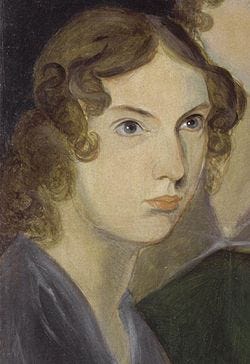
The misunderstood sister

Welcome to A Narrative of their Own, a weekly publication exploring the lives and literature of women.
If you enjoy reading essays on literature, as well as reviews of great books and recommended reading, please consider a free or paid subscription.
Back in 2024, I wrote about my favourite of the famous Brontë sisters, Emily, sometimes referred to, rather derogatorily, as “the weirdest of three weird sisters.”
Weird or not, these three sisters are surely one of the most well-known families in the history of Yorkshire, the county I hail from (albeit they in the West and myself in the South). I have studied both Emily’s Wuthering Heights extensively during my literature studies, and her older sister Charlotte’s Jane Eyre, as well as Jean Rhys’ prequel Wide Sargasso Sea.
But Anne Brontë is the one sister I have not read so much about.
I came across a biography a while ago about the youngest sister of this literary family Take Courage: Anne Brontë and the Art of Life by Samantha Ellis and must admit that it made me want to find out more about the sister of whom I knew the least about.
Born in the village of Thornton, Bradford, West Yorkshire in 1820, Anne was the youngest member of the six Brontë children. A few months after her birth, Anne’s Irish-born father Patrick Brontë became the new Rector of Haworth Parsonage, and he brought his wife Maria, from a merchant family in Cornwall, and young family of six children with him to the isolated village of Haworth on the edge of the North York Moors.
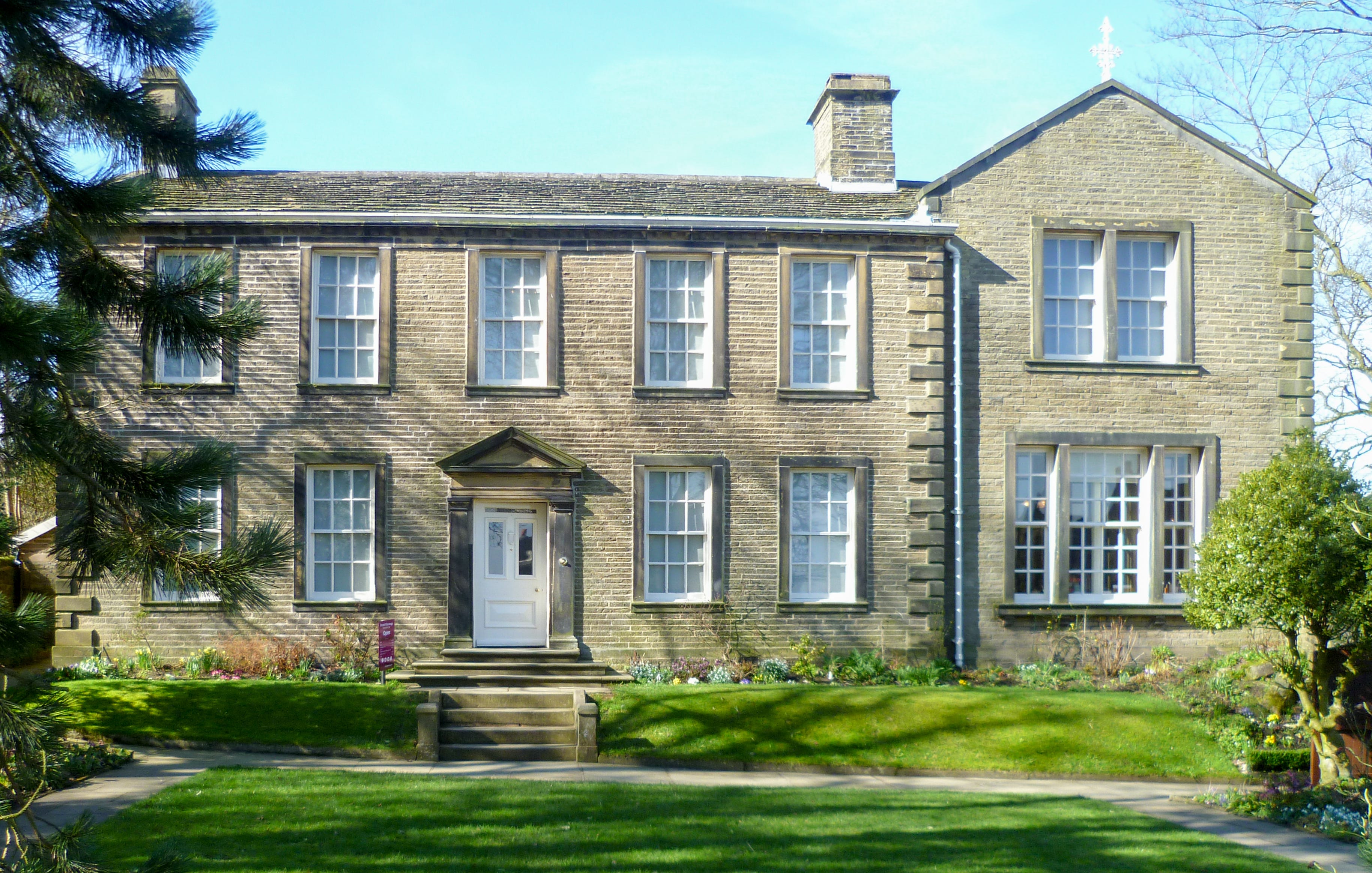
The Brontë children consisted of Maria, Elizabeth, Charlotte, Patrick Branwell (always known as Branwell), Emily Jane and Anne. The Brontë’s were a family besieged by tragedy: their mother Maria died of tuberculosis when Anne was aged just one, and her two sisters, Maria and Elizabeth, soon followed. It was the same disease that would eventually wipe out the whole of the Brontë siblings.
Anne was known to be shy and reserved but notably managed to hold down a full time job for longer than any of her siblings. Although never marrying, there have been suggestions that she fell in love with her father’s assistant curate, William Weightman, however his life was sadly cut short by cholera, and this was believed to be what led to Anne’s later poems of loss and mourning. There is little in the way of evidence to support that he was a serious suitor to Anne however, merely a written observation by Charlotte that he attempted to win Anne’s attention whilst in church, however she later acknowledged that he was a flirt with many of the local women.
It is perhaps not well known that it was in fact Anne’s poetry that was an important component in the publication of the sisters’ poetry collection.
Anne managed to persuade Emily, reticent at the thought of publishing her private words, to consent to their collected poems being sent out to a publisher, leading to their first book: Poems by Currer, Ellis and Acton Bell.
'I think of him whose faintest smile
Was sunshine to my heart,
Whose lightest word could care beguile
And blissful thoughts impart;’
Anne Brontë, ‘Mirth and Mourning’
Some critics have suggested that Anne’s less-read book Agnes Grey was a precursor to the far more lauded Jane Eyre, written a year later by her sister, Charlotte. Both books discuss the plight of the Governess in Victorian England, with Anne’s book showing a partly autobiographical story of her own experiences. Agnes Grey was published alongside her sister Emily’s single novel Wuthering Heights.
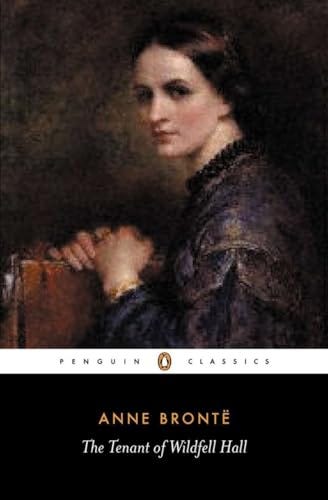
Next, Anne published The Tenant Of Wildfell Hall, a revolutionary work in many ways, dealing as it does with the subjects of alcohol and opium addiction, (no doubt gleaned from the troubles afflicting her doomed brother, Branwell), marital cruelty and infidelity, class inequality, and the right of women to choose their own path in life. It has been cited as one of the first fully formed feminist novels for its daring on challenging Victorian society and values.
As a young child, Anne had been taught both in the family home of Howarth and at Roe Head School, alongside her sister Emily, and the two girls were perhaps the closest siblings. Together, they invented the imaginary kingdom of Gondal, writing poetry and prose about this from the early 1830s until 1845.
Anne worked as a governess, firstly in 1839 and then for a clergyman’s family named Robinson for the next four years in Thorpe Green, close to the historical city of York. Unfortunately, her unreliable brother Branwell joined her there in 1843, ostensibly to work as a tutor to the children. Shortly after Anne returned home in 1845, Branwell was dismissed from the Robinson home.
In 1846, Anne contributed twenty one poems to the sister’s collaborative collection, Poems by Currer, Ellis and Acton Bell, the pseudonyms used to ensure their work was taken seriously. Anne’s first novel Agnes Grey was published together with Emily’s Wuthering Heights in 1847, with Charlotte’s Jane Eyre appearing the same year and The Tenant of Wildfell Hall appearing in 1848.
The Tenant of Wildfell Hall portrays a heroine’s unhappy marriage to a drunken, brutish husband. The novel raised some scandal, causing her sister Charlotte to reference the subject matter as morbid, and thoroughly out of keeping with Anne’s true nature. (She was similarly to denounce her other sister Emily’s efforts in Wuthering Heights).
George Moore, the Irish novelist and short story writer known for his literary and artistic discussions, wrote in his book Conversations in Ebury Street (1924) that had Anne Brontë lived ten years longer, “she would have taken a place beside Jane Austen, perhaps even a higher place.” He also went on to describe Agnes Grey as “the most perfect prose narrative in English Literature.”
Whether in agreement with Moore’s claims or not, some critics saw it as a rebalancing of the long established tendency to play down the talent of Anne. The writer, critic and modernist influencer May Sinclair, for example, had previously dismissed her as “the weak and ineffectual Anne,” with others comparing her work unfavourably to that of her sisters.
Much of this image of Anne Brontë again appears to have stemmed from her older sister Charlotte, who took on the task of biographer and critic of her work after her untimely death. There remained little in the way of letters or papers documenting Anne’s life, meaning that any information gleaned about her was from accounts written by Charlotte, whose own mediocre feelings around Anne’s literary ability and references to her religiously morbid and pensive, docile nature, became the accepted truth of her nature. In more recent years, some of these ideas have been unpicked, particularly in books such as Samantha Hills’ Take Courage.
Something which is an undisputed fact is the way in which her time spent in the Robinsons' home working as a governess shaped her ideas.
A wealthy and privileged family, the Robinsons were related to people in high places, including a marquis and a member of Parliament. Anne would likely have come into contact with such visitors as a member of the Robinson’s household, allowing her more of an education in class and the ways of the world than had she remained solely at Haworth Parsonage. Of her time spent there, only a few words remain, including this: "... during my stay I have had some very unpleasant and undreamt-of experiences of human nature."
Anne’s books are heavily concerned with morality and with the ethical principles which govern human behaviour, and both of her novels show a melancholy view of the imperfect world of which she observed.
Mrs Gaskill, biographer of Charlotte Brontë, pointed to Anne’s Agnes Grey as a pretty much autobiographical novel. However, this appears to undermine Anne’s literary skills. Many have similarly disregarded the book, not helped perhaps by the fact that it purports to be a “true history.”
Agnes Grey tells the story of a young governess from a poor clergyman father and a mother who married him despite the wishes of her wealthy parents, sacrificing her inheritance and a materialistic life. Similar to the novels of Charles Dickens, Anne’s central character feels an affinity throughout the novel with the working class characters, one of which is a poor curate of good faith and whom she eventually marries, whilst portraying an unflattering picture of the upper classes. She relays a picture of wealth equalling morally bankrupt characters.
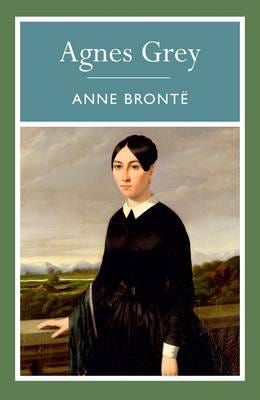
The book was received fairly well when published in 1847, but suffered from appearing together with Emily’s Wuthering Heights. Emily’s brutish novel was seen as coarse and violent, but this did mean it captured the public’s attention, leaving Anne’s novel as less powerful in comparison.
Many have made the comparison of Anne’s novel with Charlotte’s Jane Eyre, even down to the descriptions of Agnes/Jane, including crediting both of the sisters’ novels with the first introduction within English literature of the plain heroine.
Critics have also made remarks on the similarities between Wuthering Heights and Anne’s second novel, The Tenant of Wildfell Hall, with the passionate intensity shared by the central characters and the underlying violence at their heart. It also contains double narrators similar to WH. It is pretty easy to see how the siblings would have written novels along similar themes, spending so much time together and dreaming up their imaginary worlds.
Obvious connections between the depravity portrayed in Anne’s novel to the beleaguered only male sibling, Branwell, who frequently took refuge in alcohol and laudanum, particularly following his dismissal from Thorp Green. He maintained that his dismissal was due to his affair with Lydia Robinson, the lady of the house, and it was likely that Anne would have been a witness to such an affair. Branwell’s descent due to his addictions would have undoubtedly had a powerful effect on his young sister.
The Tenant of Wildfell Hall, whilst admired in some publications, was seen as morbid and coarse, with some believing the book must have been written by a man (similar to the reception of Emily’s earlier novel), and suggestions that if it were, in fact, written by a woman, well then this would make it even more problematic.
In response to such criticism, Anne responded:
"In my own mind, I am satisfied that if a book is a good one, it is so whatever the sex of the author may be. All novels are or should be written for both men and women to read, and I am at a loss to conceive how a man should permit himself to write anything that would be really disgraceful to a woman, or why a woman should be censured for writing anything that would be proper and becoming for a man."
Charlotte showed her open distaste for the novel. Referring to the largely unfavorable response to it, she stated:
"At this I cannot wonder. The choice of subject was an entire mistake. Nothing less congruous with the writer's nature could be conceived. The motives which dictated this choice were pure, but, I think, slightly morbid."
Due to Charlotte’s respectable position in 1850, her choice to disassociate with the novel resulted in a loss of interest in the book. She put the further nail in the coffin of its future by declining an offer to issue a reprint edition, stating somewhat harshly:
"Wildfell Hall it hardly appears to me desirable to preserve."
In Mrs Gaskell’s later biography of Charlotte she makes reference to Anne’s “little known” novel.
In July of 1848, Anne visited London with her sister Charlotte, the only time she would leave Yorkshire, in order to disprove rumours partly fuelled by the sister’s publisher, that the work of Currer, Ellis and Acton Bell were written by one single author. The reason for this was clear: the siblings’ publisher wished to capitalise on the success of Jane Eyre.
Attending the publishing house, Charlotte declared: “We are three sisters,” to the surprise of the publishers, who had no idea of the true identity or gender of the authors of the novels!
W. T. Hale's Anne Brontë: Her Life and Writings, published in 1929, went some way towards paving the way for a reconsideration of her work. It challenged some of the accepted tropes of Anne, seeing her gentleness as not a weakness but instead a powerful strength of character.
Riding on the sisters’ achievements of publication, more sadness was to afflict the Brontë family just one year after the publication of Wildfell Hall, when Branwell and Anne’s beloved sister Emily died in close succession, both of tuberculosis. Shortly after, Anne, too, succumbed to the disease in May 1849, leaving just her older sister Charlotte and their father Patrick alone in the cold Parsonage on the edge of the Moors.
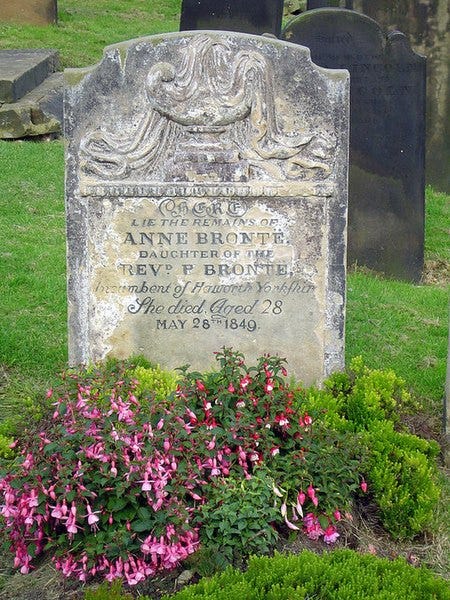
Unlike her siblings, Anne Brontë died in her favourite place, the seaside town of Scarborough on the North Yorkshire coast, leading her to be buried, somewhat unusually, in a churchyard overlooking the sea that she loved, rather than in the Haworth graveyard along with the rest of her family.


Other critics have followed W T Hale’s reassessment of Anne’s writing, and whilst Charlotte is still often considered as the most talented Brontë sister, many have suggested that had Anne’s novels received more critical attention, they would likely have been far more venerated.
The Tenant of Wildfell Hall is probably my favourite of the Brontë novels so it's great to see Anne in the spotlight for once! She's always seemed to me to be the least dramatic of the siblings in terms of character - holding down a job away from home for longest and so on - but that gives her a kind of inner steel that I'm drawn to.
Thank you for your essay about Anne. She was your subject, just so, and you placed her in her family context that poked my curiosity. So I had to do a tad more reading about them. Thank you again